EDOLUS
The EDOLUS website introduces an artificial intelligence infrastructure company through seven 3D scenes that flow into one another. The camera starts at a satellite in Earth orbit, drops into a desert city, dives into a chip inside a server room and ends up behind a car. Scrolling through it feels like watching a product launch film whose pace the visitor controls, and the music changes its arrangement with every scene. Only at the very end does the screen say Edolus never existed, and the company turns out to have been made up from the start.
EDOLUS is a showcase piece by Vertex3D, a French studio that builds 3D websites, and it won Site of the Day on both the FWA and Awwwards.
01Concept
Vertex3D builds 3D websites, and instead of presenting itself with a page of case studies, it invented a client and built that client a complete website. EDOLUS sells satellite networks in orbit, compute nodes in cities, compute arrays in server rooms and self-driving systems in cars, and the copy uses the stock phrases of that industry, such as Orbital Intelligence and Multi-Agent Orchestration. The copy does not need to hold up under scrutiny. Its job is to give each scene a heading, so that the studio has a reason to build a satellite, a server room and a car. The closing line, Now imagine your own, spells out the studio's intent, since what the visitor has just seen is not a company profile but the kind of website this studio can build for a client.
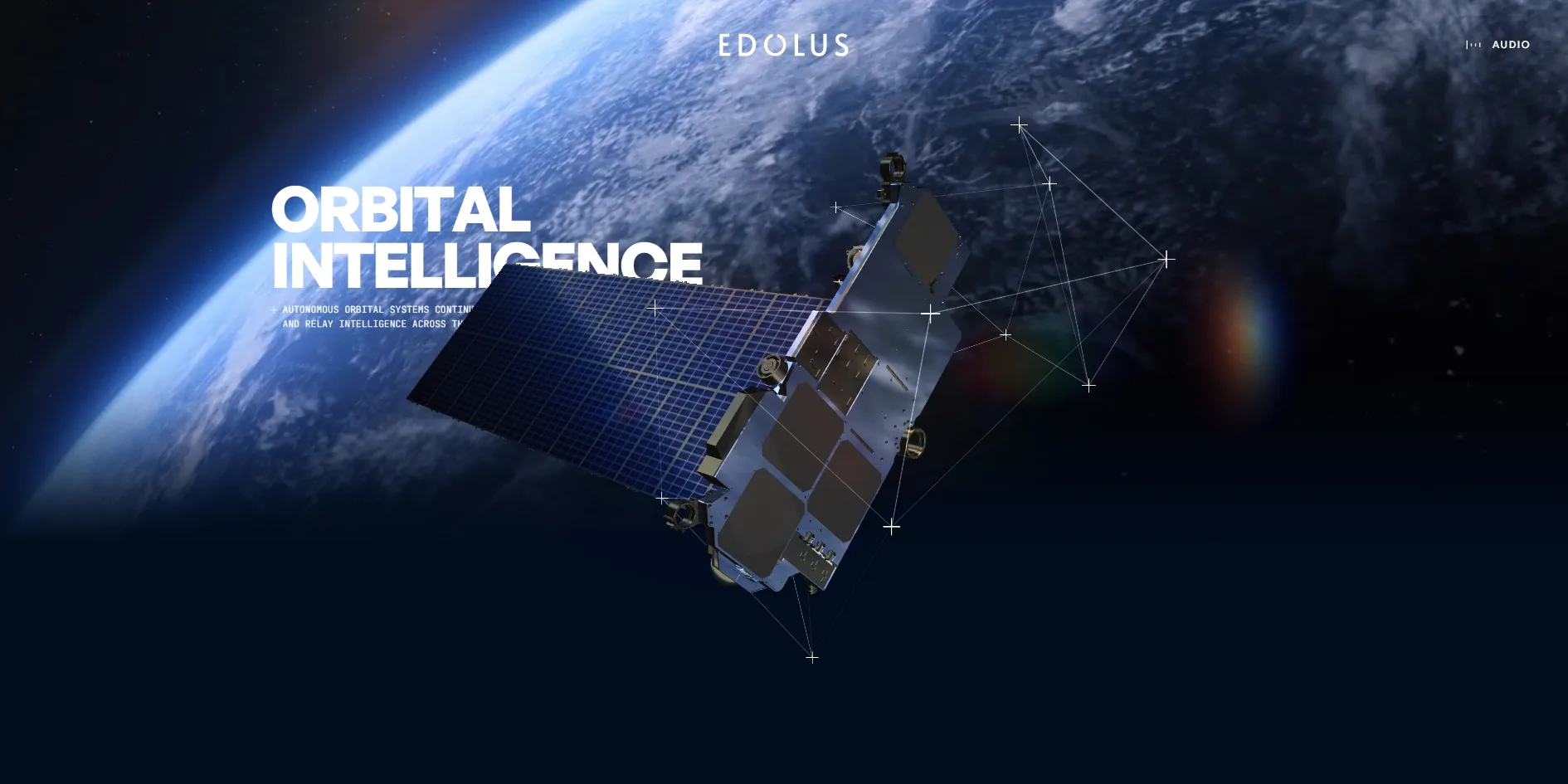
When visitors open the site, they first see the EDOLUS wordmark and a loading counter. Once loading finishes, a video of Earth fills the screen, with INTELLIGENCE AT PLANETARY SCALE in the middle and a white button labelled INITIATE SYSTEM below it. A line at the bottom of the screen asks visitors to put on headphones. When a visitor presses the button, the music starts, the camera pushes a satellite into the middle of the frame and the headline changes to ORBITAL INTELLIGENCE. A line reading SCROLL TO BEGIN then appears next to the cursor, telling the visitor to start scrolling.
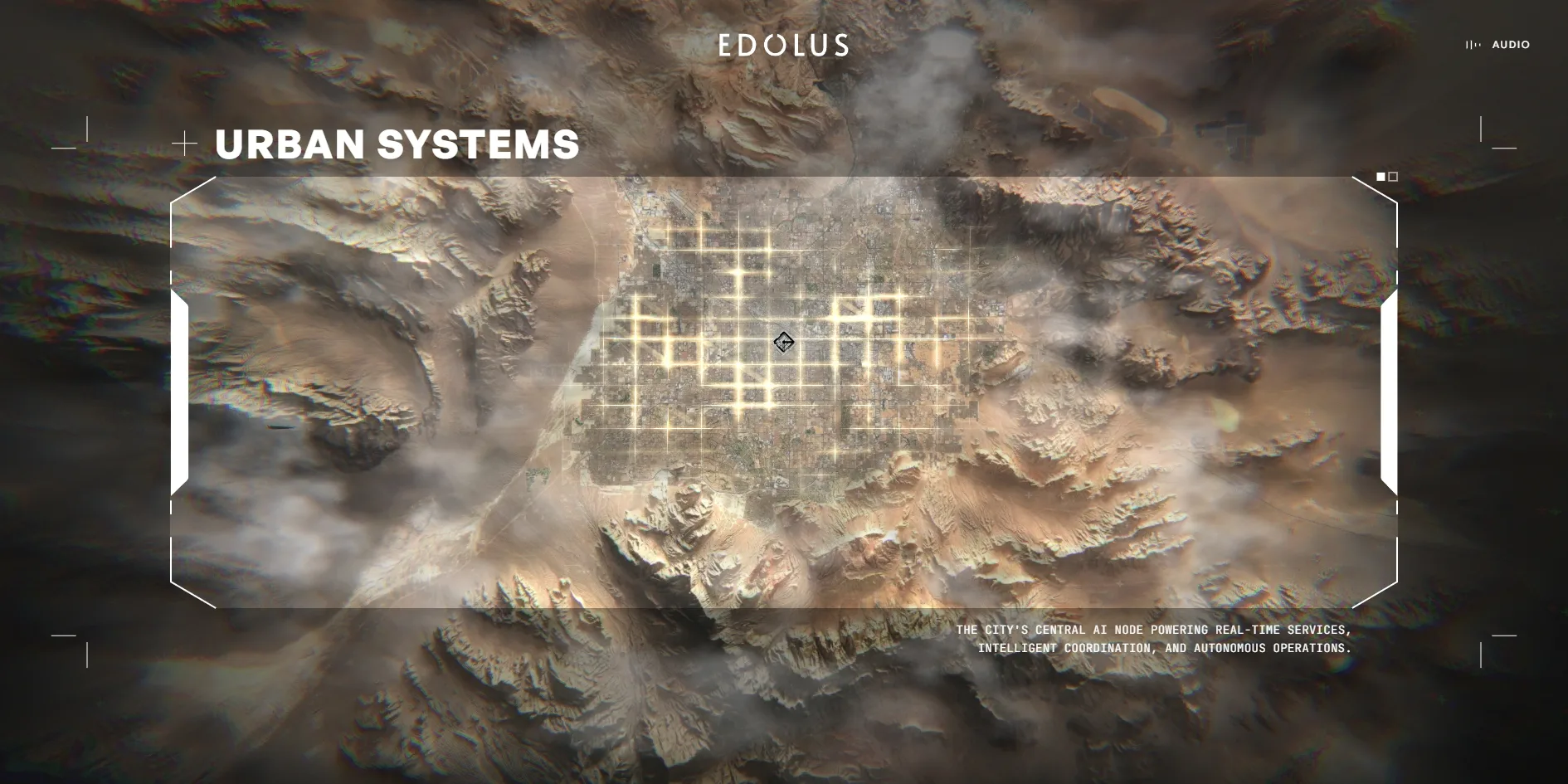
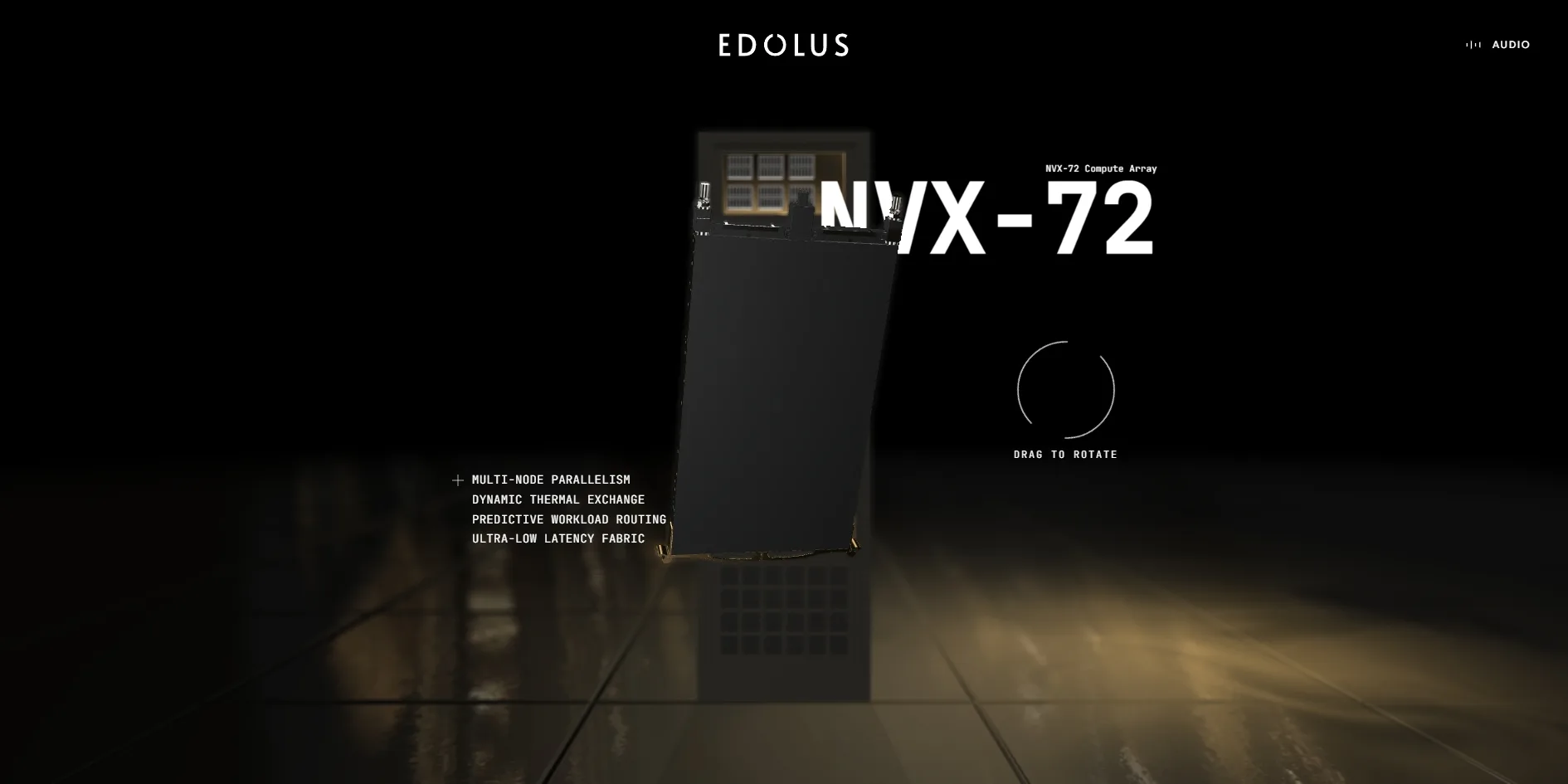
Over the first four scenes, the scale shrinks steadily as the visitor scrolls. After the satellite, a diamond-shaped node labelled PRIMARY NODE falls out of the clouds and lands on a satellite map of a desert city. The city's street grid then lights up block by block, and the headline changes to URBAN SYSTEMS. Next the camera dives into a server room corridor, where one cabinet at the far end sits in a single beam of light beside the label // COMPUTE_CORE. That cabinet then slides out a compute tray called NVX-72, and the EDL-72 chip on the tray carries the camera into a golden nebula.
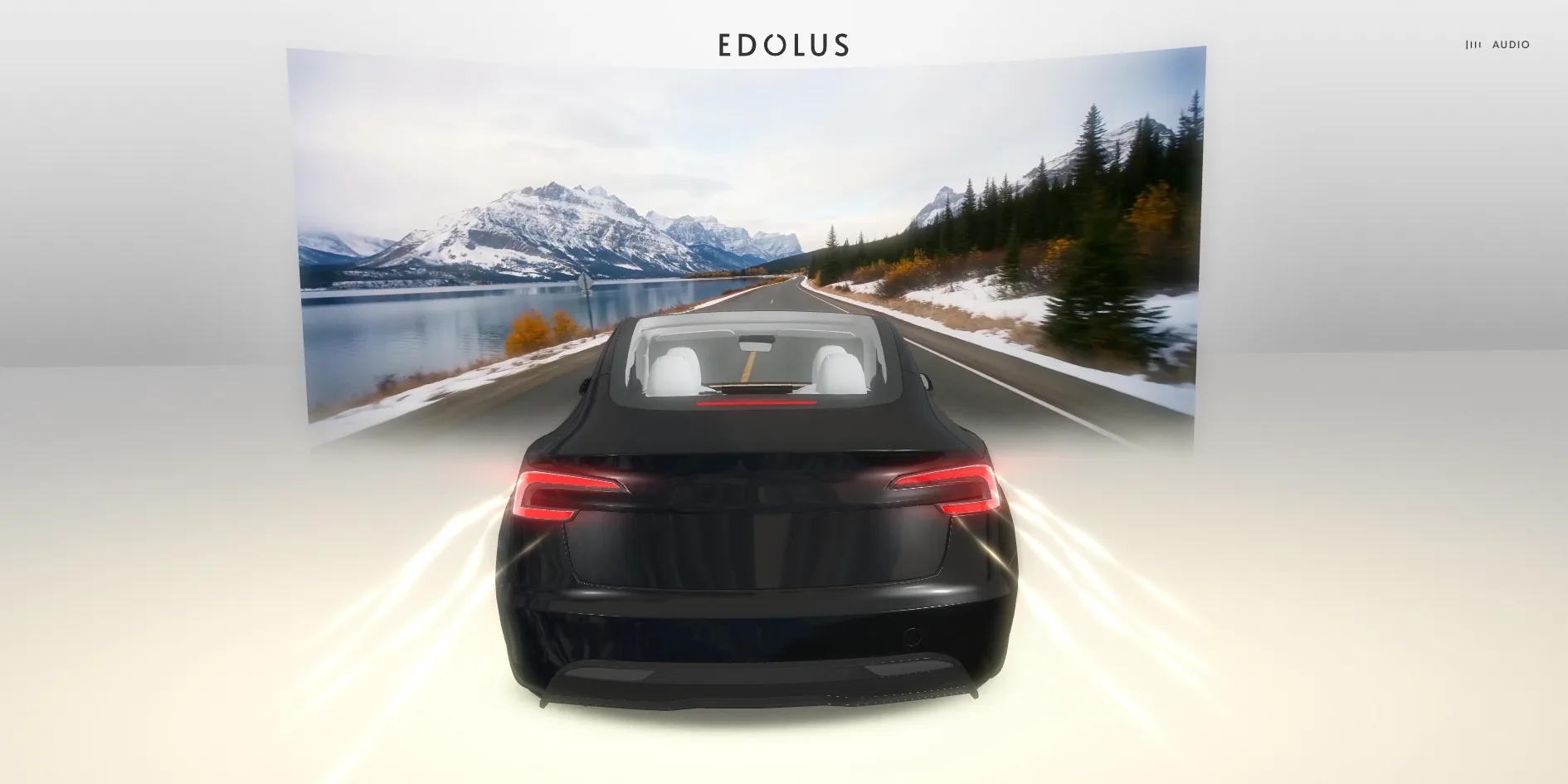
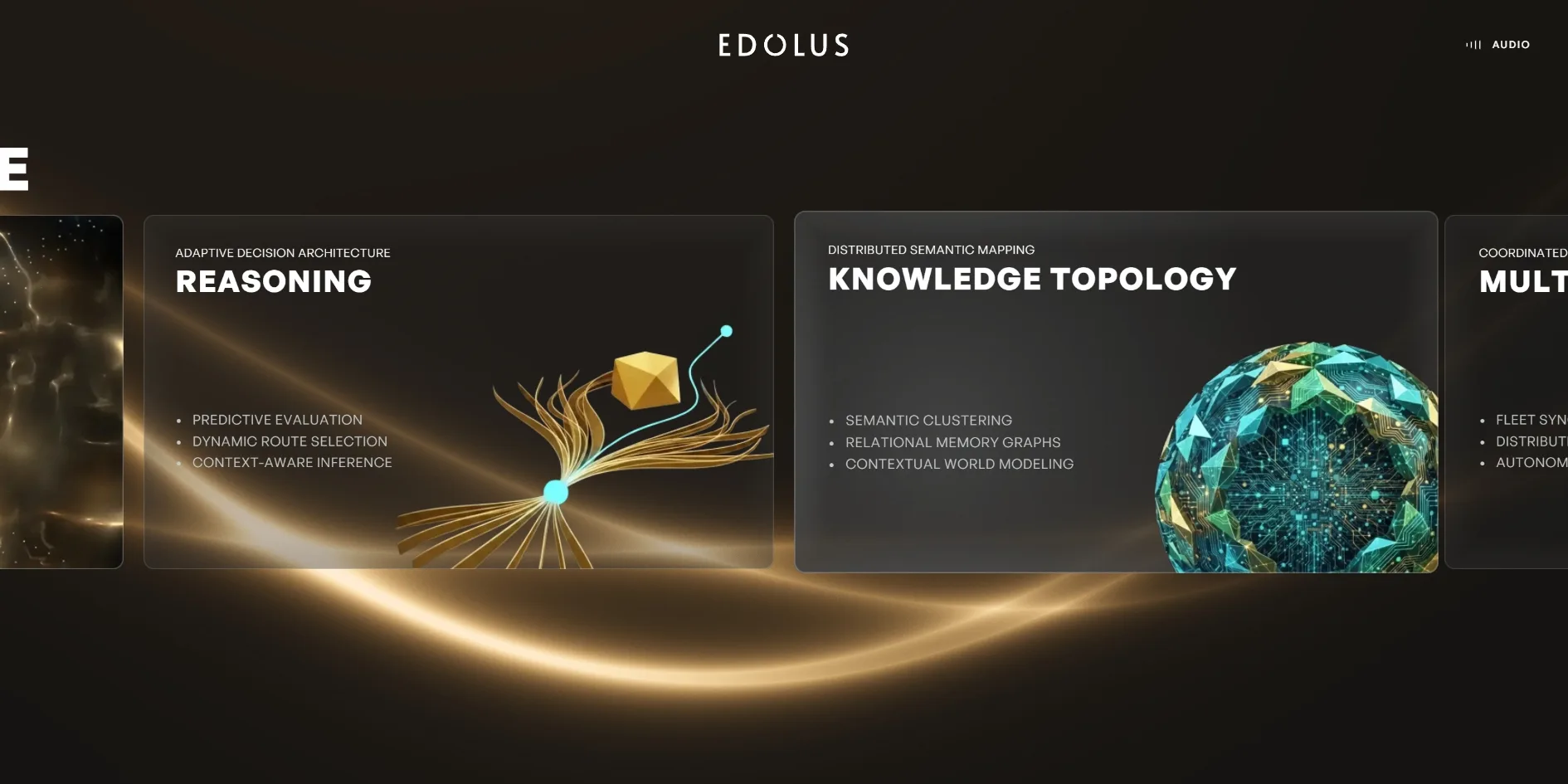
After the nebula comes the line INTELLIGENCE LAYER and a row of four cards, each covering one AI capability, starting with REASONING. The row of cards then shrinks into the picture on a car's centre screen. The camera pulls back out of the car to show it parked in front of a large curved screen that plays a road through snowy mountains. Over the whole route the scale goes down from a planet to a chip and finally back up to a single car. Then two black bands close in from above and below, and two lines appear one after the other, Edolus never existed and The experience did. After them come the studio's logo, the line Now imagine your own, an email address and a REPLAY EXPERIENCE button.
The whole route is as long as scrolling through about forty screens, with no page breaks and no menu for jumping ahead. There are few places where visitors can act, namely hovering over the satellite's label, dragging the tray around and hovering over the cards, and the rest of the time they watch. When a visitor clicks REPLAY EXPERIENCE, the site goes back to the screen before the entrance, and the visitor has to press the button again to start over.
02Design
Scene by scene, the colour runs from cold to warm and then to white. The orbit scene is deep blue space and a bluish Earth, the cloud scene turns grey and white, and the desert map is sand yellow. From the server room corridor onwards, the screen becomes black with a single beam of warm gold light. The chip, the nebula and the cards stay in that black and gold, then the car scene suddenly turns the whole screen white, and the closing bands bring it back to pure black. Each change of colour coincides with a change of scene, so colour works as the chapter break here, and visitors know they have moved on without reading a heading.
Two typefaces share the text on the page. The sans serif General Sans handles headlines and sentences. The entrance headline INTELLIGENCE AT PLANETARY SCALE is set in a very light weight, and once inside, every scene headline switches to bold capitals. The closing sentences mix regular and bold on one line, so Edolus is regular and never existed is bold. The monospaced JetBrains Mono handles small captions, labels and spec lists, including the line Autonomous Inference Core under AI CHIP and the four-line feature list beside the tray, and it reads like the spec page of a hardware launch. The product names follow the same pattern, since NVX-72 and EDL-72 are letters plus numbers in the way real chips and servers are named.
The scene headlines are not a layer of text pasted over the picture. They are placed inside the 3D space, so objects hide them as they pass. In the orbit scene, the satellite's solar panel cuts across the second half of ORBITAL INTELLIGENCE. In the server room, the compute tray covers the first letter of the large NVX-72. Product launch films often use shots where text and objects overlap like this, and the site does it in a live picture, so its headlines read less like web headlines and more like the titles of a film.
The satellite, the cabinet and the car are all modelled on real products rather than abstract tech graphics. The satellite has real solar panels and hardware parts, the cabinet has cooling grilles, and the car's body and large centre screen look very much like a Tesla Model 3. The car scene has the most unusual set. The car is not on a road at all but stands in an all-white space in front of a large curved screen, which plays a clip of a mountain road generated with the AI video model Seedance. The set resembles the virtual production stages that film shoots use. It fits the scene's copy, From digital twin to real-world execution, because visitors watch a car driving in front of a screen rather than a car driving on a road.
03Motion
The web page itself never scrolls on this site. Instead the visitor's scroll wheel pushes a timeline from start to end, with the camera, the objects and the text all placed along that line. The timeline has seven stopping points, and when visitors stop scrolling close to one of them, the picture is pulled onto it and holds there, right in front of a headline or an object they can interact with. Some stretches take more scrolling to get through. The short stretch from the chip into the nebula is the slowest, where the same scroll distance moves only four tenths as far as elsewhere. With the system setting for reduced motion turned on, the camera still flies the same way, because the site does nothing with that setting.
The seven scenes hand over to one another through continuous camera moves or objects that transform. The diamond node falls all the way from the clouds into the map, the corridor pushes in until the camera reaches the cabinet, the tray slides out and turns over, and the chip on it grows into a nebula. The smoothest handover is between the cards and the car. The row of cards draws back until it is the size of one screen, that screen turns out to be the car's centre display, and the camera then pulls back from inside the car to outside it.
The visitor's cursor changes something in every scene. Objects in the scene tilt slightly towards the cursor, as if the visitor were walking around them. Next to the AI CHIP label on the satellite sits a small ring, and when the cursor moves over it, the ring grows and a looping electronic sound plays. In the server room, the cursor leaves a curved dark ripple on the floor wherever it passes, as if someone had drawn a finger through shallow water. Later, in the card scene, whichever card the cursor rests on brightens and moves slightly forward, and a soft glow inside the card follows the cursor slowly.
Among the things the cursor can do, dragging happens only in the server room. When the camera reaches the tray, the cursor turns into a ring labelled DRAG TO ROTATE, and visitors can hold and drag to flip the tray over and see its other side. When they let go, the tray keeps turning a little on its own momentum.
Text on the site also has its own way of arriving on screen. The labels on the satellite and the map first appear as a string of random characters and then decode letter by letter into the real words, with an electronic sound each time. The wordmark at the top of the screen is always moving too, since the ring of the O in EDOLUS is wiped away every few seconds and then drawn back from the top.
The sound of the site also changes with the scroll. The site splits the music into three tracks, melody, bass and other instruments, and gives each scene its own balance between them. The server room keeps almost nothing but the melody, the chip and nebula stretch plays all three tracks at full volume, the car scene drops them very low and the ending fades to silence. A set of sound effects is tied to particular moments, so pressing the entrance button, the diamond node landing, the cabinet appearing and text decoding each have their own sound. In the nebula stretch, a looping effect follows the scroll speed, so the faster the visitor scrolls, the faster and higher it plays.
From start to finish, continuous scrolling holds a steady 60 frames per second with no stretch dropping below it. That holds even though two videos, the Earth from the entrance and the road behind the car, keep playing in the background the whole time. All seven scenes are heavy, and the site handles that by keeping only the current scene and its neighbours switched on at any moment, while every other scene is turned off entirely. The graphics card therefore only has to draw two or three scenes at once.
04Engineering
The whole EDOLUS site is a single project built with the 3D engine PlayCanvas. PlayCanvas runs in the browser and comes with an online editor. Every effect on this site is written as a small script attached to an object. The positions of the stopping points, the pace of each stretch and the music balance of each scene are all settings the team can adjust in that editor. The web page itself is only a thin layer that holds the wordmark, the AUDIO switch, a few labels and the closing lines. Values that change over time, such as volume fades, the hint beside the cursor and the closing transition, are driven by the animation library GSAP.
Before the visitor enters, the site has already downloaded about 49 MB, and almost nothing more is downloaded after that. 3D models account for nearly half of it, about 23 MB, and the two largest are the compute tray and the car at about 7 MB each. The Earth at the entrance and the road behind the car are two videos totalling about 11 MB. Textures come to about 11 MB as well, with some of them in a compressed format the graphics card can use directly and the rest as ordinary PNG and WebP images. Music and sound effects add up to about 2.6 MB, a small share of the total.
First contentful paint arrives between 0.3 and 0.55 seconds, well under Google's suggested 1.8 seconds, but what it paints is only the loading percentage. The INITIATE SYSTEM button does not appear until around 12.5 to 13 seconds, and visitors can do nothing before then. Layout shift (CLS) is 0.09, under Google's suggested limit of 0.1, so the picture barely jumps while visitors wait.
Part of that wait of more than ten seconds goes on downloading, and part of it is a deliberate warm-up. Near the end of loading, the site moves the camera in the background through two spots in each of the seven scenes and draws a few frames at each spot. During this pass it also makes the graphics card draw objects that are out of view. That way every material and texture is ready in advance, and after the warm-up the site waits another two and a half seconds before revealing the button. The smooth ride after the entrance comes from this warm-up, although during it the page stops responding for up to almost a second at a time.
Visitors who use only a keyboard cannot get past the entrance at all. INITIATE SYSTEM looks like a button but is just a piece of text, the Tab key only moves between the 3D canvas and the page itself, and neither Enter nor Space does anything. Once a visitor has entered with the mouse, the arrow keys and Page Down do move the timeline forward, but the AUDIO switch at the top right can never be reached with the keyboard.
For screen reader users the site offers even less. The scene headlines and the text on the cards are drawn inside the 3D canvas, so only a few labels and the closing lines exist as web text. The page declares no language and has no heading structure at all. The Vertex3D logo at the end is a link, yet a screen reader cannot read out a name for it.
05Scores and Team
| Award | Source | Date | Score |
|---|---|---|---|
| Site of the Day | Awwwards | 2026-10-04 | 7.2. Design 7.09 / Usability 7.05 / Creativity 7.59 / Content 7.34 |
| Developer jury score | Awwwards | — | 7.82. Semantics 7.60 / Animations 8.80 / Accessibility 7.20 / WPO 7.80 / Markup 7.60 |
| FWA of the Day | The FWA | 2026-07-28 | 83 POINTS, DAYS 3 |
On Awwwards, the strongest of the four marks for EDOLUS is Creativity, at 7.59. A made-up company, a camera line that shrinks from orbit down to a chip and music that rearranges itself with each scene together fit that high mark. Its lowest of the four is Usability, at 7.05. The button takes more than ten seconds to appear, scrolling is taken over by a timeline that snaps to its own stopping points, and the keyboard cannot get through the entrance. These may be part of why Usability came in lowest.
On the developer side, EDOLUS received 7.82, though the award page does not yet show a Developer Award badge. Leaving responsive design aside, Animations scored highest at 8.80 and Accessibility lowest at 7.20.
EDOLUS took FWA of the Day on 28 July with 83 points, more than two months before Awwwards. The team's description on the FWA calls it a cinematic WebGL journey into AI infrastructure that pushes the limits of real-time 3D, immersive UX and dynamic sound design. The description tells the story of EDOLUS the company and does not mention that it is fictional, so visitors only learn that the company was made up when they reach the end. The FWA files it under three categories, design and production studios, experimental and music and sound, and the last one describes exactly that three-track score which changes with each scene.
| Credit | Who they are | Track record |
|---|---|---|
| Yann Trevelot / Vertex3D | A French studio for spatial web and enterprise interface design, whose own portfolio is controlled by AI tracking of the visitor's hands and head instead of clicks | Awwwards works 2, SOTD 1, HM 2. FWA 2 |
The track record in the table is cumulative as of the time of writing. On both Awwwards and the FWA, the credit goes no further than Yann Trevelot and his studio Vertex3D, with no public breakdown of who else did what. The studio's own portfolio won FWA of the Day on 23 April 2026 with 82 points, and EDOLUS is its first Site of the Day on Awwwards.
06Archive
- Award date
- 2026-10-04
- Awards
- Awwwards SOTD 2026-10-04, The FWA FOTD 2026-07-28
- Site
- https://edolus.com/
- Credits
- Yann Trevelot / Vertex3D
- Design
- cinematic
- Build
- scroll
- Awwwards
- 7.2 / 10. Design 7.09 / Usability 7.05 / Creativity 7.59 / Content 7.34. Developer Award 7.82. https://www.awwwards.com/sites/edolus
- The FWA
- 83 POINTS, DAYS 3. https://thefwa.com/cases/edolus
- Stack
- PlayCanvas, GSAP, Basis texture compression, Cloudflare
- Total assets
- About 49 MB, all downloaded before the entrance, including about 23 MB of 3D models and about 11 MB in two videos
- Speed
- FCP 308–552 ms (loading percentage), entrance button at about 13 s, CLS 0.09. Continuous scroll 60 fps